My Account
-
Buyer
Register as a Foriegn Buyer
-
Seller
Log In Register as a Seller
My Account
Buyer
Seller


ITC-HSN: 0704
Min Order Qty 250 KGS (Kilograms)
Accept Small Orders
Fulfilment Capacity (Per Month): 100000 KGS (Kilograms)/month
Product not available
Most nutritious snack.
Perfect Snack for Diabetics.
Contact us for
INTRODUCTION
Foxnut is commonly known as Makhana is an important aquatic crop. The scientific name of
Makhana is Euryale ferox Salisb. The Makhana seed of an aquatic herb is a monotypic genus
of the family Nymphaeaceae and is characterized by its hard seed coat (shell), black in colour
and round shape with a diameter ranging from about 5 mm to 15 mm . Its seed is also called
as Black Diamond. It is commonly known as Gorgon nut, Fox nut and Makhana in India.
It is grown in stagnant perennial water bodies like ponds, land depressions, oxbow lakes,
swamps and ditches. It is a plant of tropical and subtropical climate. For its proper growth
and development, the conductive range of air temperature is 200C to 350C, relative humidity
50% to 90% and annual rainfall 100 cm to 250 cm.
Makhana plant is considered as native of
South-East Asia and China, but distributed to almost every part of the world. Its distribution
is extremely limited to tropical to sub-tropical regions i.e. South-East and East Asia and is
known to exist in Japan, Korea, Russia, North America, Nepal, Bangladesh and India. India
and China are the only countries where Makhana is cultivated as crop. In India it is mainly
distributed in the states of Bihar, West Bengal, Manipur, Tripura, Assam, Jammu & Kashmir,
Odisha, Rajasthan, Madhya Pradesh & Uttar Pradesh but commercially produced in few
states only.
In Bihar major Makhana producing districts including Darbhanga, Madhubani, Sitamarhi,
Saharsa, Supaul, Araria, Purnea, Kishanganj, and Katihar. In West Bengal major Makhana
producing districts limited to Malda & Uttar Dinajpur.
Makhana is considered as an aquatic cash crop in India Bihar in India is the leading state in
its production and processing. It is estimated that Bihar accounts for more than 80 percent of
total Makhana production in the country. The total area under Makhana cultivation in India is
estimated to be 15000 Ha. It yields 1,20,000 MT of Makhana seeds, which after processing
yields 40,000 MT of Makhana Pop. The estimated value of the production at farmers end is
Rs 250 crore and it generates revenue of Rs 550 crore at trader’s level.
In Darbhanga district of Bihar, Research Centre of Makhana under control of ICAR Research
Complex of Eastern Region was established for research on different aspects of Makhana.
Table 1.1 Nutritional Content of Makhana Seed and Popped Makhana
Parameters Makhana Seed Popped Makhana
Carbohydrate(% by wt.) 57.0 79.8
Protein (% by wt.) 7.2 8.7
Fat (% by wt.) 0.3 0.5
Moisture (% by wt.) 34.7 10.4
Total Ash (% by wt.) 0.3 0.4
Crude Fiber (% by wt.) 0.5 0.2
Amylose (%) 19.0 18.2
Calorific Value (K.cals/100g) 259 358
Phosphorus (mg/100 g) 66.1 53.2
Potassium (mg/100 g) 35.6 42.0
Iron (mg/100 g) 0.8 1.4
Calcium (mg/100 g) 9.5 18.5
Magnesium (mg/100 g) 11.3 13.9
Sodium (mg/100 g) 48.2 71.0
Copper (mg/100 g) 0.3 0.5
Manganese (mg/100 g) 0.9 1.3
Zinc (mg/100 g) 0.9 1.1
USES OF MAKHANA
Makhana is stored in two forms via seeds and Makhana pop. In India it is mainly consumed
in popped form and in China it is consumed medicinally or for food. Makhana is the popped
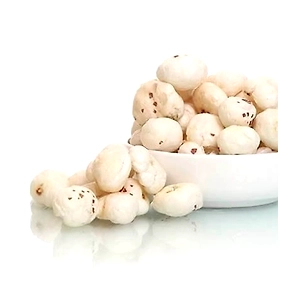
expanded kernel of the foxnut or gorgon nut. The nuts are collected from water and popped to
remove the edible starchy kernel. The expanded kernel of the nut obtained through this
process is called popped kernel and is known as Makhana in India.
Makhana pop has several
uses. It is a highly relished food consumed as namkeen, kheer, curry, and so forth. Makhana
pop is traditionally consumed as a snack, high-protein, low-fat food, sweet component and it
has been used in traditional medicine. Popped Makhana is used in the preparation of a
number of delicious and rich sweet dishes like Makhana kheer, vermicelli, halwa, flour,
puddings and various other sweet dishes. The Flour produced from Makhana is used as
substitute of Arrow Root. The flour is also used to make delicious dishes like sweet meat,
soups, Makhana kheer and as thickener in different foods preparations.
Makhana is consumed as a non-cereal food by devotees during their fasts. Hence it solves the
religious purpose. In every religion, Makhana is considered as the pious and divine food item.
In Hindu religion, it is used in all the worshiping ceremonies, Hawan, Pooja etc. In addition
to this, due to his heavenly nature, it is considered as the best offering to god and goddesses
in temples. Even the Muslim Communities consume lot of Makhana during their festival of
Eid. Makhana seeds are very rich in carbohydrate content.
In Manipur, Makhana is produced for
its vegetable purpose where the well developed and almost matured fruits are picked up
before their bursting and sold as prime vegetable in the markets. In some parts of Manipur,
young fruits and leaf petiole is used as salad. Even seeds of matured fruits are used for the
preparation of a number of local delicacies.
| Established in: | 1997 |
| Bussiness Type: | Public Company |
| Bussiness Type: | Manufacturer, Merchant |
| MSME: | Yes |
| Export Turnover (3 years): | Less than US$10,000 |
| Certifications: | APEDA RCMC |
| Countries would like to export to: | Australia, Belgium, Canada, China, Germany, Philippines, Russia, United Arab Emirates, United Kingdom, United States |
| No of employees: | 1-10 |